
The landscape of American broadband infrastructure underwent a seismic shift with the recent federal guidance regarding the Broadband Equity, Access, and Deployment (BEAD) program. This evolution, often discussed as the BEAD technology neutrality ruling, effectively removed the long-standing “fiber-first” mandate that previously dominated the allocation of the $42.45 billion funding pool.
However, while the technology used to deliver the signal is now neutral, the physics of the infrastructure, specifically the utility poles that carry these networks, are not. The regulatory change hasn’t softened the rigid deployment deadlines or the engineering precision required for pole attachments. Relying on legacy aerial data collection methods in this new environment is a direct threat to the financial viability of a bid.
The BEAD program, part of the U.S. government’s efforts to expand broadband access to underserved areas, aims to provide funding for broadband infrastructure deployment.
A key component of the program is the technology neutrality ruling, which requires that the data collected for deployment planning and progress reporting must not favor any one technology over another. This means that broadband deployment data can be collected via a range of sources.
However, while the goal of technology neutrality is to encourage a fair and inclusive approach to data collection, the quality of that data can vary significantly depending on the method used.
Traditional aerial data collection methods often face challenges such as obstructions, low measurement precision, and slow post-processing cycles, which can cause delays in planning and implementation. As a result, these outdated systems may introduce significant risks to timely BEAD compliance and broadband rollouts.
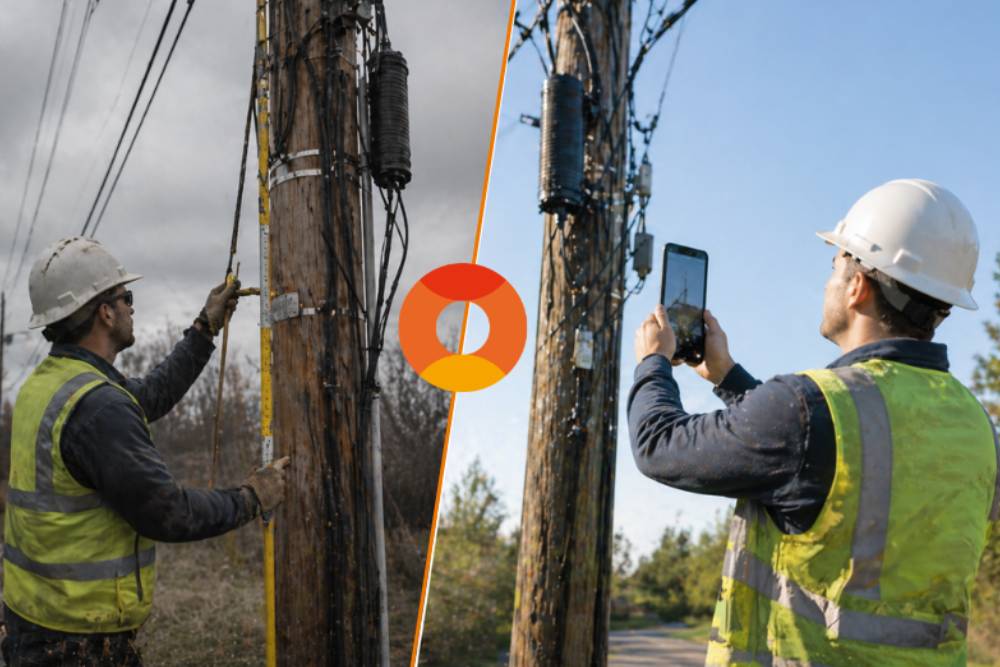
For decades, the standard procedure for measuring utility pole attachments and evaluating structural integrity has remained remarkably stagnant. It often involves two-person field crews, heavy physical hardware, and manual height sticks.
In the context of a modern, tech-forward deployment, these methods represent a massive bottleneck. When a field technician spends twenty minutes on a single pole just to calibrate equipment or manually record measurements, they are limiting their daily output to a fraction of what is required to meet 2026 milestones.
The industry average for traditional data collection often plateaus between 40 and 100 poles per day. In a competitive bidding environment where the lowest outlay per location wins the award, these labor-intensive processes inflate project costs.
Furthermore, the lack of real-time visibility means that the office-based engineering team often waits days or even weeks to receive field data. If an error is discovered in the office, the cost of a “truck roll” to re-survey the site can erode the thin margins characteristic of these large-scale infrastructure projects.
To thrive under the current neutrality rules, providers must adopt a mobile-first approach that prioritizes efficiency. We founded D8Averse with the specific goal of eliminating these friction points.
By utilizing an iOS-native platform, we enable a single technician to perform the work that previously required entire teams and specialized machinery. This transition from “heavy iron” to a streamlined digital interface is what allows a workforce to scale rapidly across vast BEAD territories without the logistical nightmare of managing complex hardware fleets.
Our process centers on the concept of instant synchronization. When a field technician uses augmented reality to capture pole data, the information syncs immediately to a secure web interface.
This allows an engineer in a different city to begin structural analysis and make-ready engineering almost the moment the field scan is completed. This level of concurrency is what separates a project that meets its deployment window from one that falls into the trap of regulatory non-compliance.
The shift toward technological agnosticism means that fixed wireless and fiber projects will frequently share the same aerial real estate. This makes the accuracy of a “digital twin” (a precise virtual replica of the physical infrastructure) paramount.
In the past, “good enough” measurements often led to NESC violations or disputes between attachment owners. In the current era, precision is a requirement.
Modern visualization tools allow every stakeholder to see exactly what is happening at the pole level without leaving their desk. By capturing detailed measurements through a mobile device, we provide a verifiable record that can be reviewed at any time. This transparency reduces the friction of contractor collaboration and ensures that every attachment meets safety standards before a single wire is hung.
One of the most significant risks to any broadband deployment is the shortage of skilled labor. Legacy measurement tools often require extensive training and specialized knowledge to operate correctly. This creates a dependency on a small pool of experienced technicians, which can stall a project if turnover occurs or if a team needs to scale up quickly.
A tech-forward solution removes this barrier. By simplifying the capture process to a “point and scan” workflow, we reduce the required training time to minutes rather than days.
This democratization of data collection means that new team members can become productive immediately. When a single technician can consistently survey 180 poles per day with high accuracy and zero hardware calibration, the economics of the project shift dramatically.
The updated BEAD guidelines place a premium on “speed to deployment.” Under these rules, states are encouraged to look at how quickly an applicant can move from the award to an active network. If the data collection process is disconnected from the design process, one is essentially building a bridge from both sides and hoping they meet in the middle.
We emphasize a workflow where data is a living asset. Immediate access to measurements allows for real-time decision-making. If an engineer sees a pole that requires significant make-ready work, they can re-route or adjust the design instantly, rather than waiting for a post-field report.
As we look toward the coming construction seasons, the distinction between “innovative” and “essential” has blurred. The flexibility granted by technology neutrality is a gift to the industry, but only if providers have the operational backbone to support it.
The transition to an iOS-only, mobile-first data collection strategy is a primary way to future-proof your organization. It ensures that you are not anchored to obsolete hardware or slow, manual processes that cannot keep pace with the demands of the federal government.
The window for meeting the rigorous demands of the new BEAD environment is closing, and the winners will be those who prioritize efficiency over tradition. We invite you to see how a mobile-first, AR-driven approach can triple your field productivity and secure your deployment deadlines.
To learn more about how we can help you maximize your project’s potential, contact our team for a demonstration of our streamlined capture technology.
Media Contact