
Behind every fiber network expansion, 5G rollout, and grid modernization project is a network of utility poles that must safely support new attachments. While funding gaps and labor shortages dominate industry headlines, utility pole maintenance challenges remain one of the most underestimated causes of network deployment delays.
These challenges rarely surface during early planning. Instead, utility pole maintenance issues emerge mid-project, when timelines are compressed and margins are tight, triggering design revisions, permit adjustments, and unexpected field construction rework. As fiber and broadband deployments accelerate nationwide, the ability to identify and address utility pole maintenance risks early is becoming a defining factor in whether projects stay on schedule or stall.
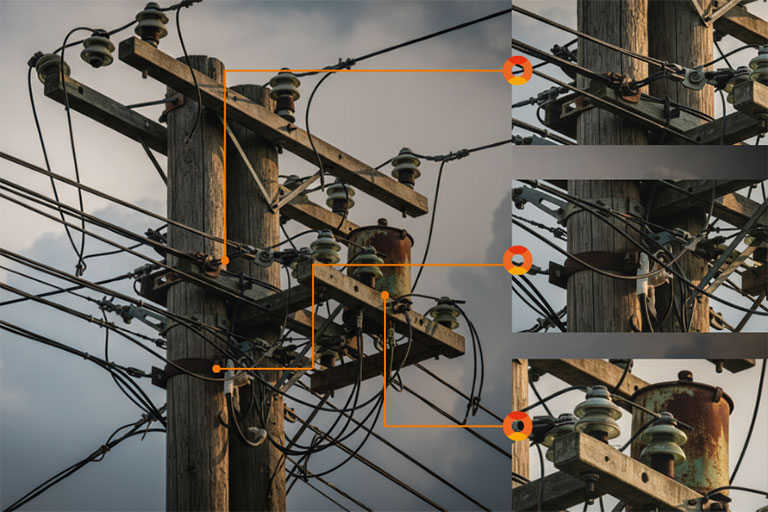
Utility poles were never designed for today’s high attachment density. Decades-old pole infrastructure now supports layers of legacy equipment alongside new fiber optic, wireless, and electric utility assets, increasing structural and clearance risks as networks expand.
A pole that appears viable during planning can later fail load analysis, violate clearance standards, or require unexpected make-ready work. When discovered late, these issues disrupt engineering, permitting, and construction schedules.
The problem is not the existence of risk. It is the lack of early visibility into utility pole maintenance conditions before it becomes a critical deployment blocker.
Aging utility pole infrastructure remains a persistent challenge. Wood poles deteriorate over time due to moisture, insects, and long-term weather exposure, while steel and concrete assets face corrosion and cracking as they age.
Without accurate, up-to-date field data, these risks are difficult to detect early. Surface inspections and outdated records can overlook structural weaknesses, leading to poles being approved during design but failing during make-ready or construction. Late-stage discoveries introduce engineering redesigns, permit revisions, and additional utility pole maintenance work in the field, delaying broader network deployment timelines.
As broadband expansion and wireless network deployments accelerate, poles are carrying more equipment than ever before. Overloading has become a leading cause of make-ready delays.
When measurements and attachment data are incomplete, load calculations rely on assumptions rather than verified field measurements. If a pole cannot safely support additional equipment, plans must be revised, reinforced, or replaced. These late discoveries extend timelines and introduce avoidable delays across the entire deployment project.
Many delays stem from outdated, inaccurate, or fragmented utility pole records. Legacy documentation may include attachments that no longer exist or fail to capture recent installations, storm damage, or emergency repairs.
When field conditions do not match design assumptions, work pauses. Surveys must be repeated, discrepancies resolved, and coordination reestablished between field teams, engineers, and pole owners. In many cases, utility pole maintenance challenges are driven less by physical defects and more by the absence of reliable, current data.
When utility pole issues surface late in the deployment process, they disrupt carefully sequenced deployment plans. Engineering teams must revisit designs, permits may require amendment, and construction crews can be delayed while maintenance resolutions and make-ready adjustments are coordinated.
In large-scale builds, even a small percentage of problematic poles can impact overall schedules. In projects tied to funding milestones or regulatory deadlines, these delays carry financial and compliance risks.
Many organizations still rely on utility pole inspection workflows built for a slower, less complex infrastructure environment. Manual measurements, paper notes, and delayed uploads create data blind spots that prevent early identification of structural or clearance issues.
When field data takes days or weeks to reach engineering teams, proactive adjustments are no longer possible. By the time risks are identified, construction plans are already underway, making utility pole maintenance challenges far more disruptive and costly than necessary.
Leading telecom and infrastructure organizations are shifting from periodic pole inspections to continuous, real-time pole data strategies. Early visibility into pole conditions allows risks to be identified before they impact permitting, design, or construction schedules.
D8Acapture enables this shift through mobile-first field capture using a single iPhone. Technicians document AR-accurate measurements, pole attachments, and GPS-tagged photos in one visit, with data instantly synchronized to engineering and operations teams. By connecting field capture directly to network planning and engineering workflows, maintenance issues can be addressed while designs are still flexible, reducing construction rework and protecting deployment timelines.
As fiber, broadband, and utility infrastructure deployments accelerate, utility pole maintenance can no longer be treated as a secondary concern. Early identification of structural risks, attachment conflicts, and data gaps is essential to protecting schedules and budgets.
Organizations that invest in accurate, real-time utility pole data gain a decisive advantage. real-time pole data reduces uncertainty, strengthens coordination between field and engineering teams, and prevents maintenance issues from becoming costly network deployment delays.
The future of telecommunications network expansion depends not just on building faster, but on seeing infrastructure risks earlier in the planning process.
Media Contact